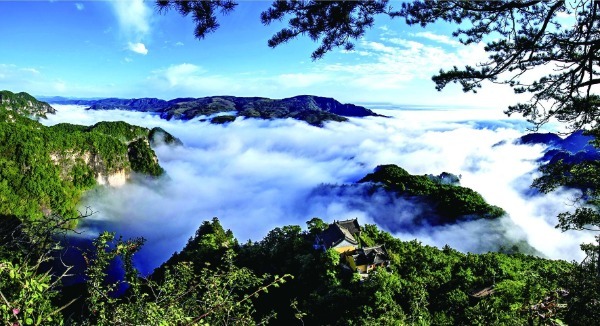
Kongtong Mountain
Introduction
Kongtong Mountain, located in Pingliang city, Gansu province, is a significant geographical and cultural landmark in China, renowned for its connection to the ancient Silk Road. Standing as a natural fortification at the western exit of the central Shaanxi plain, it has historically served as a strategic point along this ancient trade route. The mountain is celebrated for its breathtaking vistas and rich biodiversity, with elevations ranging from 1,456 to 2,123.5 meters, and its main peak reaching 2,123 meters. With a vertical height of 667.5 meters, Kongtong Mountain is enveloped in lush greenery, boasting a forestation rate of over 95% across its expansive 83.6 square kilometers.
The mountain's allure is not only in its natural beauty but also in its historical and cultural significance. Legends and historical accounts speak of its association with significant figures in Chinese history, such as the Yellow Emperor and other emperors who have visited the site. Kongtong Mountain is also revered as the "First Taoism Mountain in China," a title that underscores its prominence in Chinese spiritual and cultural life. As a sacred site of Taoism, it holds immense historical and religious value, being one of the birthplaces of this ancient philosophy.
History
According to legend, the Yellow Emperor, a progenitor of Chinese civilization, visited the mountain to seek the counsel of Guangchengzi, a sage known for his wisdom. This legendary meeting contributed to the mountain's reputation as a cradle of Taoist thought. Historical records indicate visits by the First Emperor of Qin and Emperor Wu of the Han Dynasty, adding to its illustrious heritage. Literary figures like Sima Qian, Du Fu, and Bai Juyi have praised the mountain, enriching Chinese literature.
In modern times, Kongtong Mountain has been designated a national key scenic spot and one of the first batch of 5A tourist attractions, highlighting its importance as a site of natural beauty and cultural heritage. It is also recognized as a national geo-park and nature reserve.
Cultural Significance
Kongtong Mountain's association with Taoism is one of its most defining characteristics. As one of the sacred mountains of Taoism, it symbolizes the principles of emptiness, lustration, and naturalness, core tenets of Taoist philosophy. The mountain is believed to be one of the birthplaces of Taoism in China, a status that attracts pilgrims and tourists who seek spiritual fulfillment and a deeper understanding of this ancient way of life. The Taoist influence is evident in the mountain's serene landscapes, which include numerous peaks, dense forests, and peculiar rock formations that evoke a sense of mystique and wonder.
The majestic beauty and cultural significance of Kongtong Mountain have inspired a wealth of literary and artistic expressions. Poets and scholars like Sima Qian, Du Fu, Bai Juyi, Zhao Shichun, Lin Zexu and Tan Sitong, have immortalized it in Chinese literature. In visual arts, the mountain captivates artists and photographers, as seen in events like the 2016 Photography Biennale of Tianshui, ensuring its legacy as a subject of artistic inspiration endures.








